
By Kristie Valdez-Guillen
Read Part 1
This interview was originally published in Discover Nikkei, the online journal of the Japanese American National Museum.
Kristie Valdez-Guillen (KVG): There’s this power of art to serve as a bridge and as a memory, even as non-Nikkei artists. That’s how I am interpreting and understanding your work, particularly with the kori: you’re bearing witness to internment having happened in the first place.
Sophie Constable (SC): Yeah, and it’s one of those kind of tricky spaces, I think, because, on the one hand, the experience in Canada really brought home how personal and sensitive these stories can be, with that experience that I had with my grandmother being played out in Nikkei families in Canada, where that generation had sometimes struggled to tell the next generations their story. That is a process that is still happening and needs space to happen within a family as a very private thing.

Édouard Glissant talks about how people have a right not only to privacy but, particularly for those who have been publicly discriminated against, the right to opacity.
At the same time, from my perspective, people didn’t intern themselves. It is a private story, but it’s also a much wider story. It’s Australian history, and it needs the broader society to understand that and to understand their own relationality with that story. And so I needed to be part of finding ways—safe ways, I guess—to be able to engage people with that story, to start having that conversation.
For me, that was an important aspect of the collaborative project I’m currently involved with, When You Call My Name. WYCMN invites people to create an artwork of any kind for one of the 208 people who died while interned as ‘Japanese Enemy Aliens’ in Australia or New Zealand during WWII. We’ve had 166 people adopt one or more internees and engage with their experiences through art, and hundreds more engage as the project is exhibited in Australia and overseas—it’s now taking root in Canada too. Every time one of the participants shares how they were brought to tears by the story of their adoptive kin, I feel like our web of memory is growing and strengthening.
KVG: That’s powerful. I see the decolonial heart in it, too. You spoke really eloquently about how, as we breathe life into space, and it breathes life into us, there’s this mutually constitutive process of becoming for both the person and the land. And I just wonder if you could speak to how those themes of place-based belonging connect to the broader Nikkei relationships to land or displacement in the history you’re examining?
SC: Elysha Rei’s work influenced me—especially her pieces on uprooting and introduced species. She worked with fuki, a plant brought from Japan that became a weed in Canada. She found it still growing at sites of wartime incarceration because people had planted it while trying to survive.
That metaphor resonated deeply. My background is in science, but I see ecology not as classificatory but as connecting—as a bridge to Indigenous ways of understanding the world. People are integral parts of the environment. So I’m constantly asking: what is my relationship to Country? How am I working on that? How am I bringing that into what I’m doing? Because it’s always there, and it’s often unspoken, and that’s often to the detriment of Country.
So it’s something that, by working with it or through it, keeps it present in my mind and keeps it present in what I’m doing, in the story that I’m telling.
It’s also a really tangible connection to stories that can seem terribly distant, almost lost in the past, particularly from a non-Nikkei perspective—for example, Nikkei links between Australia and Brazil.
For my portrait for Taís Koshino’s grandmother, Yasuko Emilia Koshino, I focused on a detail that stayed with me from Taís’s memories. She talked about how during World War II, on their farm in Brazil, Taís’s grandmother was a young woman in charge of feeding mulberry leaves to the silkworms, making silk to send to America for parachutes for the Pacific war.
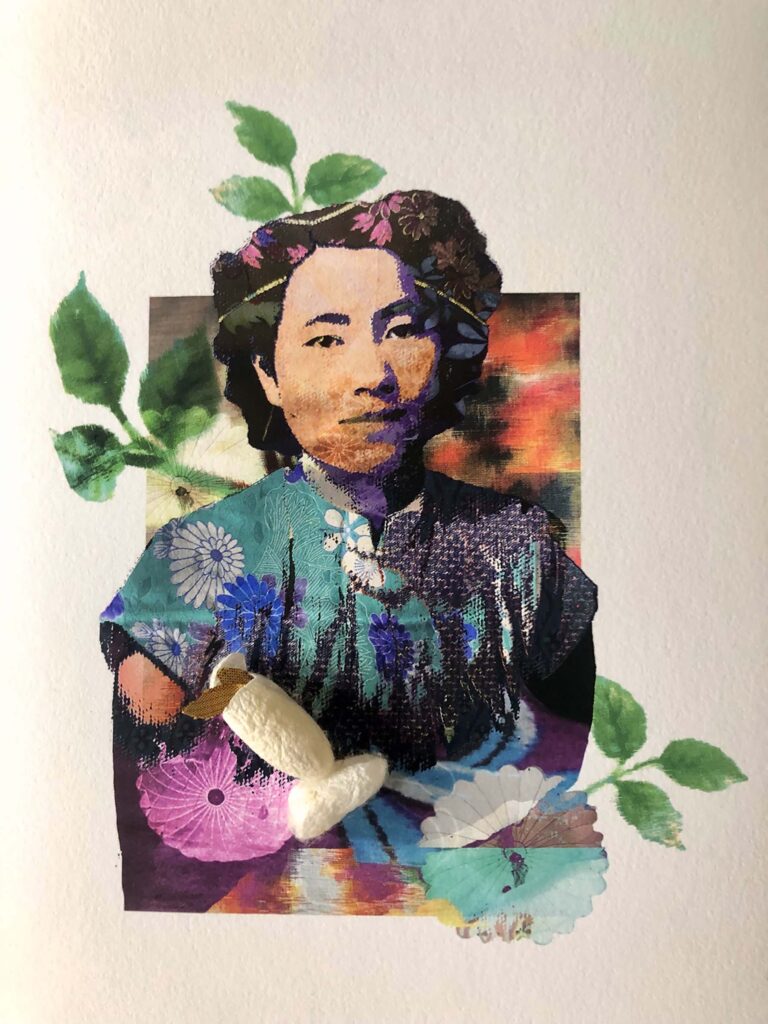
Yasuko Emilia Koshino, 2025. By Sophie Constable
Not only were these part of Australia’s wartime defense—used silk parachutes were the best source of fabric for wedding dresses in Australia during the war—they are featured in our war museums here in Australia, so it’s something people can envisage and connect with.
In retelling this story, I was given the cocoons of silkworms grown in Australia to work into Vovó Emilia’s portrait. I stitched into it a little golden silk moth, made from kimono silk, emerging from the cocoon—a little material reminder of connecting to Country and those ideas of ongoing cycles and transformations.
The kori, for me, talk about mobility and fluidity, the giving of yourself in many places and the resulting entanglements of identity beyond exclusionary classifications of “Japanese” or “Australian,” in a way that resonates, I guess, with my settler ancestries and the re-settling in my life.
KVG: You spoke earlier about using kimono fabric. What do you see as the poetry in using kimono to tell these stories?
SC: It wasn’t always received well in Australia. I haven’t often found kimono to be part of the local Nikkei narrative. But for me, the fabric itself was so rich, visually and historically.
I found I wasn’t brave enough to cut an undamaged kimono. It didn’t feel right. These older fabrics carry stories. I felt that, from a contemporary point of view, digital quilting was a way that I could sort of recreate a link. It’s been a way of reconnecting stories and working with concepts that are recognized by contemporary audiences as a way to interrogate ideas of identity.
Because part of what happened in Australia had to do with assimilation, and a lot of the Nikkei cultural history that has been passed on in other places could not be passed on here. It wasn’t a safe place for that to happen.
But you see a lot of the younger generations seeking out reconnection now, changing their inheritance.
KVG: I’m curious about your senninbari project. Could you share more?
SC: In the U.S., I saw how Nikkei mothers and sisters had created senninbari for their menfolk in the military, something I knew of because I’d seen one at our War Memorial with such a touching story.
As I was told the story, this senninbari had been on display when an elderly woman came to see it and said, “That was my son’s.” It had belonged to one of the sailors who had died in the mini-submarine attack of Sydney Harbour during World War II. When the Australian military were preparing his body for cremation, they didn’t burn the senninbari. They sent his ashes back home, but put the senninbari on display.
His elderly mother had traveled to Australia after the war and recognized the work she had stitched with her community—a thousand stitches, each by a different person wishing him well. The Memorial gave the senninbari back to her, and in return she left a book of poems about peace.
So I knew of senninbari as a Japanese practice from this story, but in the U.S., at JANM and the Presidio, I saw it as a Nikkei practice too. I was talking about this with members of Henry Ide’s family and discussing how it just wouldn’t have been possible in Australia at the time—but what about now?
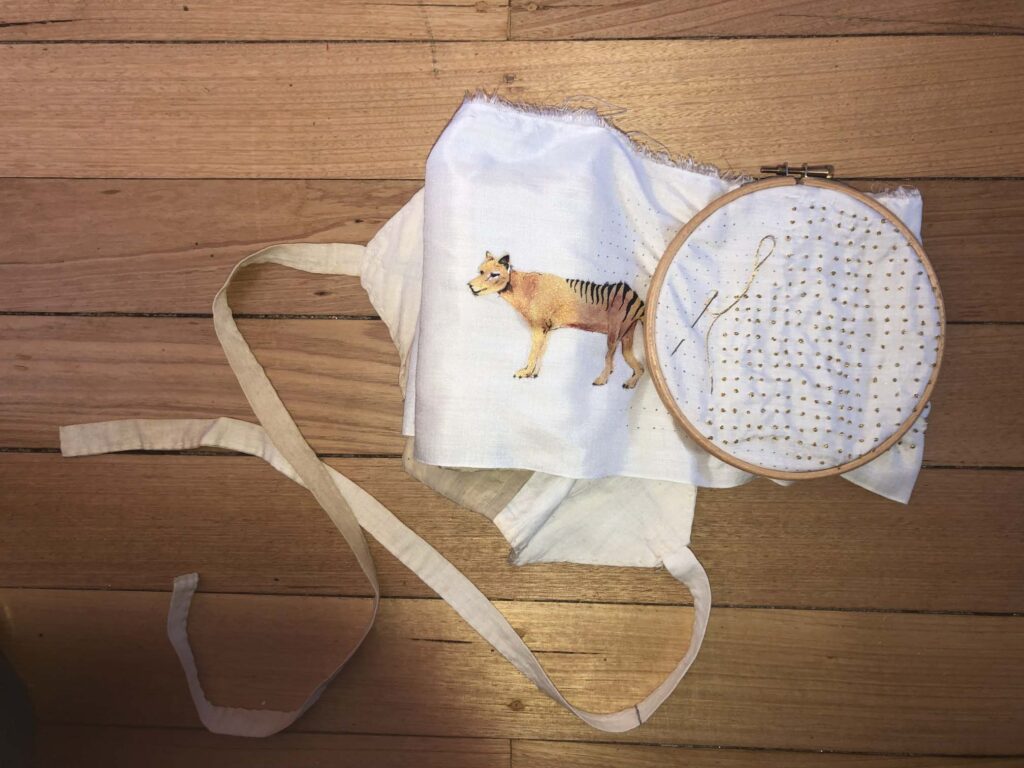
Could we create senninbari retrospectively to show contemporary community support for Nikkei war service, to emphasize what did not happen, reflect on why, and show that Australian society has changed? And the family have said it’s been really touching to see people get involved with it—though it’s a long-term project: a thousand stitches turns out to be an awful lot!
KVG: Your portraits use bright colors, while the kori use more muted tones. What meaning do you find in that difference?
SC: The kori deal with families of people who have been incarcerated and physical place-based materiality, such as plant dyes. The theme needed, and the materiality gave, a more gentle palette.
The portraits, though, encompass a wider scope within a smaller space. They needed to hold the vibrancy of a life—to stand out, side by side, and speak loudly.

Matsu Hasegawa, 2025. By Sophie Constable
I even used gold embroidery, which I’d never used before. I’m not a “gold” person! But it felt right. For example, Matsu Hasegawa’s portrait uses yellow and pink inspired by her love of pickles—a small detail, but it invites the viewer in.
One of the reasons given for keeping Henry Ide incarcerated was that he acknowledged liking Japanese food. It seems absurd now, but it reminds us how identity is constructed and reconstructed over time, and how cultural markers that were once grounds for suspicion become embraced and valued within society.
KVG: Your understanding of diaspora seems deeply non-linear. Could you say more?
SC: Absolutely. I’m intrigued by the diversity of narratives: some families didn’t just move once and settle. The stories span multiple countries—Australia, Japan, Indonesia, Canada, Panama, Brazil. To understand those stories, you have to engage transnationally.
Our identities in this region have been globally connected for a long time, even if we like to, or others want to, frame our identity more narrowly. I remember Patrick Chamoiseau’s words: we must construct ourselves. The imagination of contemporary individuals is directly connected to their capacity to enter into relationships with the cultures of the world, with the planetary biome, but also, and above all, to enter into a relationship with the chaos of the multiplicity of themselves.
And if you’re not doing that, then what are you doing?
KVG: You’re inviting us to be more dialectical, rather than binary, right?
SC: Yeah—that brings it back to the weaving! The tension between interweaving threads is what makes us whole.
KVG: It all comes back to the loom! That ties into the final question: what does it mean to you to be recognized by Nikkei Australia and Discover Nikkei? Not just as an artist depicting Japanese Australian stories, but as someone deeply engaged in conversations about memory and care?

SC: That’s another big question. Nikkei Australia are a group of such incredibly generous people that have made this safe space where people can have these conversations. And it’s so incredibly humbling to be a part of that. I don’t think I would be an artist today without people like Mayu Kanamori nurturing me to keep thinking through these ideas through art.
Care, for me, is everything. In a world that can feel quite disconnected, how do we show care? I remember organizing a workshop during which we heard a participant’s family had been in an accident. The non-Indigenous participants gave them space to process their emotions. But the Indigenous Animal Management Workers offered long, heartfelt hugs. That reshaped how I think about care.
I think Nikkei Australia is one of those spaces where it’s safe to care. People are so incredibly generous, and by making themselves vulnerable, talking about these stories—there’s such an enormous generosity of spirit to create that space and to invite people in, like me and like others, to have those conversations so that we can all sort of move forward.
I hope if my work can help people to have a deeper understanding of our societies and their histories, even if it’s just one person, then it’s been worthwhile. So thank you, Discover Nikkei, for being part of that!
Dr. Sophie Constable is an academic artist and scholar researching the history of Nikkei peoples in the Pacific alongside community engagement with Nikkei histories. Her work spans education, art, and museum sectors. Sophie’s connection to Nikkei contexts is not through her ancestry, but through common social fabrics in which she sees members of society as emmeshed together, their histories interwoven and tugging on each other.
Currently, she is a doctoral researcher in the School of Culture, History and Language at the Australian National University. Her PhD investigates how art shapes transwar remembrance of Nikkei relationality across Australia and Tonga.
All photos supplied by Sophie Constable


Recent Comments